Struggling?

This word is used a lot. People struggle with their feelings, struggle with a problem, struggle with finances, struggle with beliefs. If someone were to ask how my writing is going, right now I would say I’m struggling. It’s early in this new novel, early in the process of getting to know new characters, trying to build their worlds. It’s a daunting task. But struggling?

When I looked it up, the definition I found was, “forceful or violent effort to get free of restraint or constriction.” Restraint? Maybe. Constriction? Kind of. But forceful or violent? I don’t think so. Writing can be difficult for sure, but the rewards of having put words on paper that tell a story, portray characters in a way that makes readers feel something far outweigh these feelings of being inadequate and lost.

Instead of a forceful or violent effort, I’m taking a simpler and gentler approach, one that I believe will work for me. I’m starting again. I realize I have become much too attached to what I have written so far, so attached I have become reluctant to admit it’s not working, that it’s not good enough, strong enough or genuine enough to support the rest of the story. I know better, but I have been doing it anyway.

It’s like when you’re going somewhere, whether it’s to a physical place or an event, and you start having second thoughts. You have a feeling you should turn around, and even when the feelings get stronger you keep going, maybe telling yourself, Well, I’ve gone this far . . . The last thing you want to do is turn around and go back, but sometimes that’s exactly what you need to do. Maybe not all the way back to the beginning, but where you took that turn or went right at the fork when you should have gone left. Or maybe, like me, a new beginning is exactly what is needed.

As a writer, I know I need to be willing to go all the way back to that very first sentence, examine what I’ve written as closely and objectively as I can, and let go of what doesn’t work. I know that out of these thirty or so pages I have put time and effort and heart into there will be a sentence, a character’s thought or observation, maybe a paragraph that is real and true and belongs in the telling of this story.

I already feel better knowing this, having this plan to begin again, instead of struggling to work with what I have been desperately trying to hold onto that isn’t working. I will continue to work every day, doing my best to develop a solid understanding of the truth of this story, holding onto the belief that I can eventually trust where I’m going.

A Sense of Direction

Many people who know me know I have a poor sense of direction. While we sometimes refer to our older son as “the human map,” I am pretty much the opposite. When I am finding my way in a strange place (without the benefit of GPS), whether on a street or in a building, it’s a safe bet that whichever direction I think I should go is wrong. Almost always, it’s the other way. I am finding this is true as I begin my third novel.

I am slowly, but pretty surely, finding my way into the first seedlings of this story–writing the draft, writing about writing the draft, as well as thinking and daydreaming about my characters and what they want. It’s all part of the work and world of writing.

Each morning I go over what I’ve written the day before, and this early in the process, as I make my way in the near-dark, I find myself changing some details to the opposite of what’s on yesterday’s page.

This morning, I realized two of the new characters, people I am just getting to know, are not who I thought they were (or who I tried to make them be). The boy I thought was a nice, normal kid, maybe even a little too good, isn’t. And the man I thought was a shady and even dangerous guy, isn’t so bad. There is, of course, a possibility these early characters won’t even make it into the final draft. Or they will reveal themselves to be crucial to the story. Just as with any journey, I need to keep going as I find the right and true direction, and have faith I will get there.

Oh, and the working title for this novel? A Detour Home.

Almost There, With Gratitude

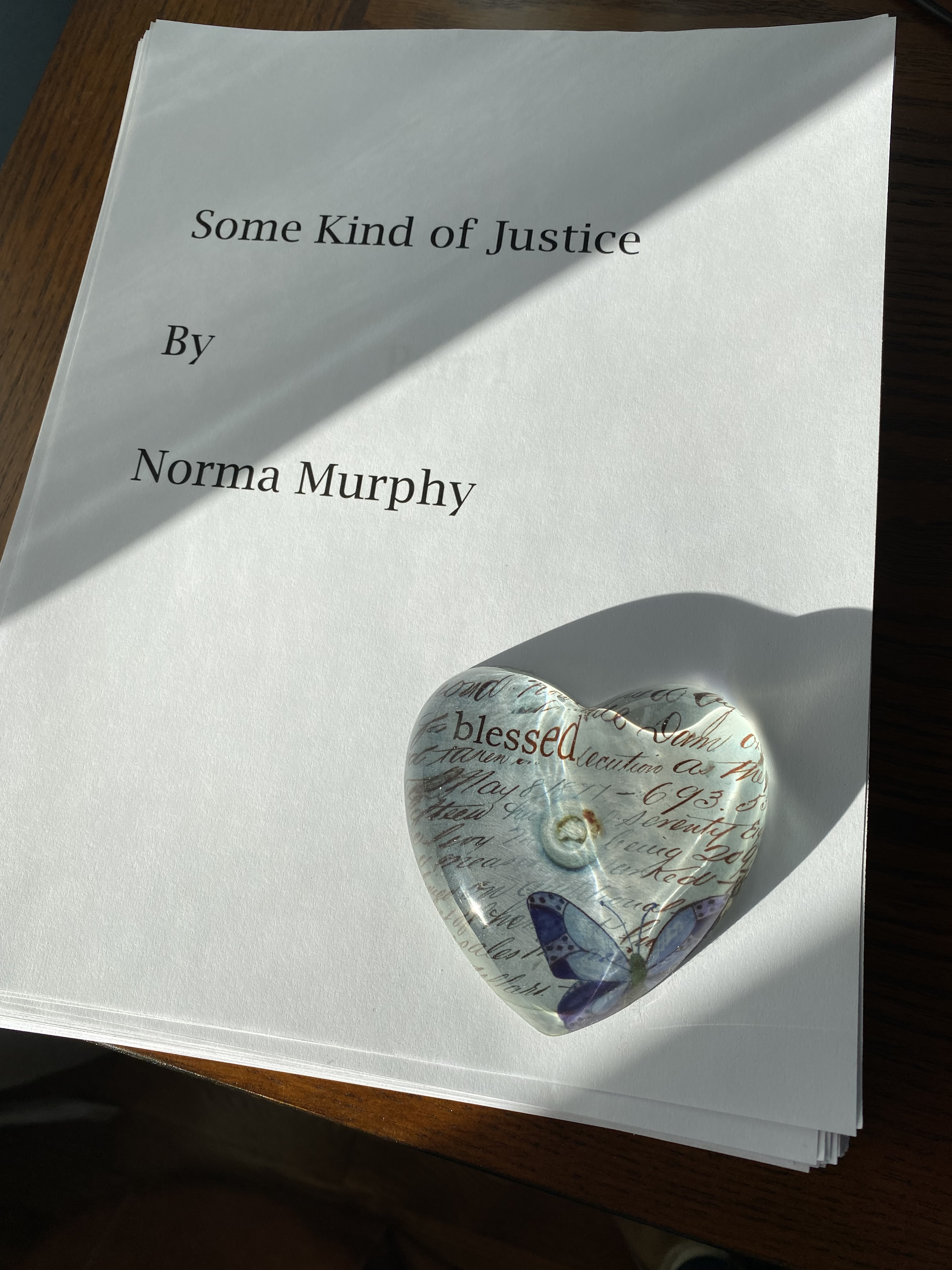
Before A Better Life was published, just over three years ago, I began work on my new manuscript, which I called A Thousand Secrets. When people ask how my writing is going, if I have another novel yet, “I’m working on it,” I respond. “Making progress,” I say. And I have. And now, after countless drafts and revisions, suggestions from early readers, and a professional developmental edit, I have a completed 91,000-word manuscript. And a new title: Some Kind of Justice.

As with my first novel, I am in the process of deciding whether to seek an agent or to self-publish again. I now know firsthand the hard of work self-publishing and marketing, but I also know the incredible sense of accomplishment it brings. There is also a lot to be said for having complete control over every aspect of the publishing process and the joy of having independent book stores accept my book and honor it with a place on their shelves.

Even after three years, people are still buying and talking about A Better Life. I had a friend reach out last week who noticed the similarities between the novel and the heartbreaking events in New Hampshire involving a missing little girl, Harmony. The next day, a reader reached out to tell me how much she enjoyed the novel and that her book club chose it for this month’s reading and discussion. She, too, noticed the parallels between A Better Life and the tragic story of Harmony. My heart goes out to this little girl and I pray for her safe return. Maybe being a writer, being open to endless possibilities, helps me envision a hopeful scenario in which Harmony is somehow safe and protected by someone who is caring for her and will eventually return her to her mother.

I will be forever grateful for readers taking the time to write to me, to the positive reviews I have received on Amazon, as well as to the people I meet who tell me how much they enjoyed A Better Life. My new novel, Some Kind of Justice will be published this year. Whether it is through a traditional publisher or self-published, it will be in the hands of readers, and hopefully find a place in their hearts and minds as well.

Looking Ahead

I was never one to look ahead too much, if at all, when it came to writing stories. I believed in letting things unfold moment to moment, and that planning beyond that would somehow stifle the writing with expectations or burden it with constraints, that it would evolve into my story instead of the characters’ story, which would be no story at all, or a bad one.

This second novel I am working on is happening differently than the first, moving a little more steadily as I allow myself to look ahead, sometimes a little and sometimes more than a little. In looking ahead, there have been times I have had some incredibly moving and important revelations, sometimes about a character’s past that affects the future, but even more so about what is coming next. These insights give me not only a better understanding about why a character says those particular words in that particular way, or why a character has such a strong attitude about certain things, but they help me move the story along as authentically as I can towards a complete story.

Sometimes a conversation or image or event that does not belong in the chapter I am working on at the moment comes seemingly out of nowhere. These are some of the most joyful moments of writing for me. I get it down as best as I can, these notes and words from the characters, things they can’t wait to say or do. When scenes are that clear, I can be cautiously optimistic they are true and belong in the story (or at least it is important that I know them). At this point in the writing process, heading towards a complete first draft, most everything is included.

I have always been a planner, except when it came to my fiction writing. As a teacher, I loved planning lessons and writing assignments for my students. I have always loved planning road trips and I love planning parties and dinners. Now my writing process has evolved, allowing me to look ahead into the lives of my characters and plan, at least a little, when it comes to writing their story.

It is difficult for many of us to look ahead and plan too far or too much in life right now, at least with any certainty. I am hopeful we will return to our lives and loved ones soon. In the meantime, I am grateful every day for my many, many blessings.

Patience

On my desk I have a tiny frame given to me by a student my first year of teaching third grade. Two fairies surrounded by flowers float around the edge and in it is a reminder I typed for myself years ago.

IMG_2663

I first framed my mantra when I had stacks of correcting, first in elementary school, then in middle school where I had hundreds of pieces of writing from students in grades five through eight. Instead of letting myself be overwhelmed, I remembered: A little at a time. It is important to remember this when it comes to my writing.

I have always thought of myself as a patient person, which has been most helpful as a parent and a teacher,  now as a grandparent, and always as a wife. As a writer, though, my patience often deserts me. In a first draft I sometimes find myself careening through a chapter instead of focusing as I should on all the small and important details that make the story richer. I get so involved sometimes in two characters having a conversation that I have pages of dialogue and not much else. These conversations are important and revealing for sure, but I know if I don’t slow down a bit and pay attention, I may miss something — a gesture, a smell or a sound, a look — details that can affect everything about the story.

I don’t have a specific word or page count that I strive for every day. Each day brings its responsibilities and demands on time, but as long as I write and feel I made progress, moved the story along and learned something about my characters, questioned things I thought I knew, it is a good day of writing.

As I revise, it is clear which pages I wrote a little too quickly and didn’t listen as closely as I should have. I’m patiently listening now, slowing down as I reread and retype and learn. A little at a time.