Almost There, With Gratitude

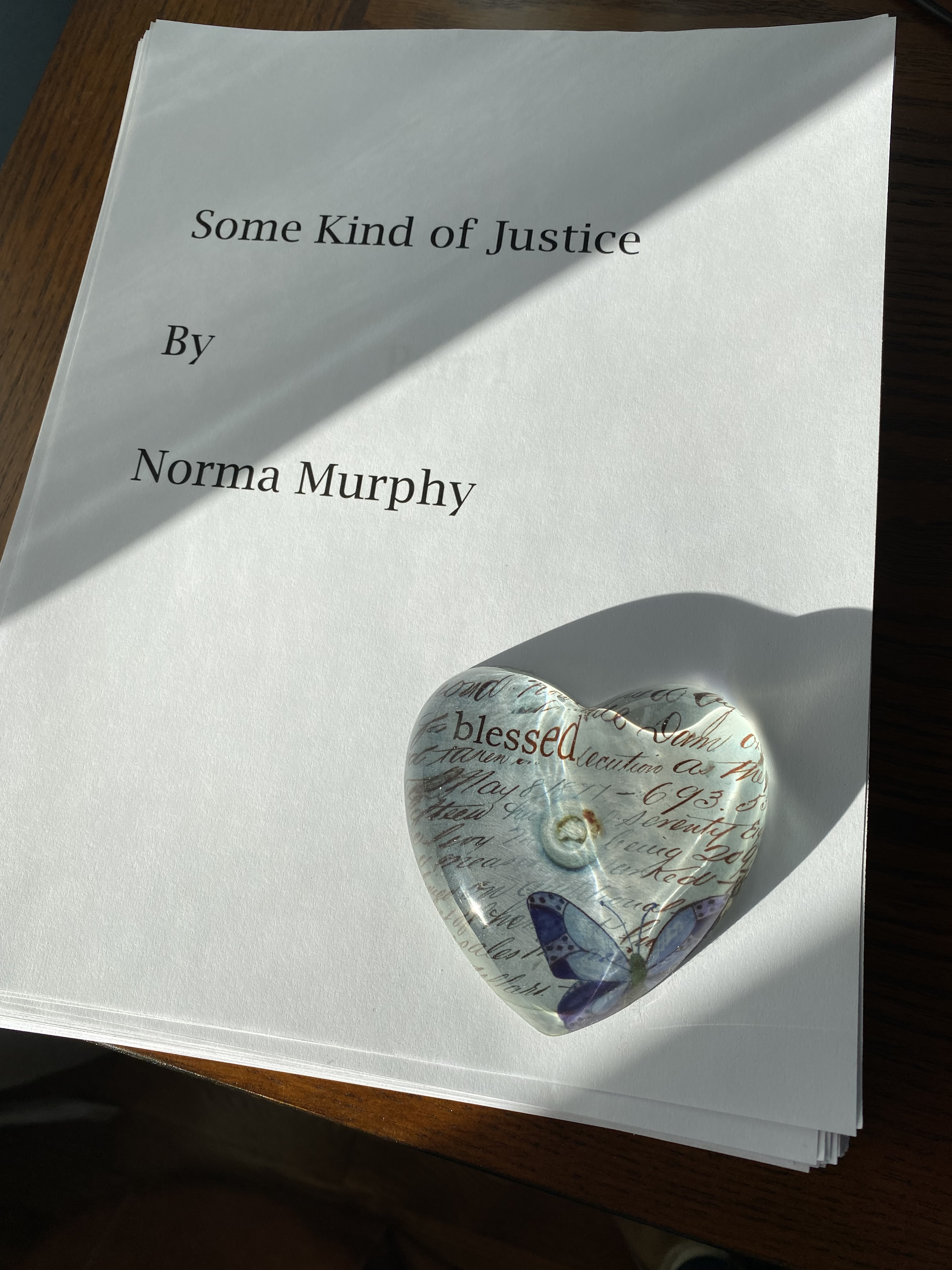
Before A Better Life was published, just over three years ago, I began work on my new manuscript, which I called A Thousand Secrets. When people ask how my writing is going, if I have another novel yet, “I’m working on it,” I respond. “Making progress,” I say. And I have. And now, after countless drafts and revisions, suggestions from early readers, and a professional developmental edit, I have a completed 91,000-word manuscript. And a new title: Some Kind of Justice.

As with my first novel, I am in the process of deciding whether to seek an agent or to self-publish again. I now know firsthand the hard of work self-publishing and marketing, but I also know the incredible sense of accomplishment it brings. There is also a lot to be said for having complete control over every aspect of the publishing process and the joy of having independent book stores accept my book and honor it with a place on their shelves.

Even after three years, people are still buying and talking about A Better Life. I had a friend reach out last week who noticed the similarities between the novel and the heartbreaking events in New Hampshire involving a missing little girl, Harmony. The next day, a reader reached out to tell me how much she enjoyed the novel and that her book club chose it for this month’s reading and discussion. She, too, noticed the parallels between A Better Life and the tragic story of Harmony. My heart goes out to this little girl and I pray for her safe return. Maybe being a writer, being open to endless possibilities, helps me envision a hopeful scenario in which Harmony is somehow safe and protected by someone who is caring for her and will eventually return her to her mother.

I will be forever grateful for readers taking the time to write to me, to the positive reviews I have received on Amazon, as well as to the people I meet who tell me how much they enjoyed A Better Life. My new novel, Some Kind of Justice will be published this year. Whether it is through a traditional publisher or self-published, it will be in the hands of readers, and hopefully find a place in their hearts and minds as well.

Looking Ahead

I was never one to look ahead too much, if at all, when it came to writing stories. I believed in letting things unfold moment to moment, and that planning beyond that would somehow stifle the writing with expectations or burden it with constraints, that it would evolve into my story instead of the characters’ story, which would be no story at all, or a bad one.

This second novel I am working on is happening differently than the first, moving a little more steadily as I allow myself to look ahead, sometimes a little and sometimes more than a little. In looking ahead, there have been times I have had some incredibly moving and important revelations, sometimes about a character’s past that affects the future, but even more so about what is coming next. These insights give me not only a better understanding about why a character says those particular words in that particular way, or why a character has such a strong attitude about certain things, but they help me move the story along as authentically as I can towards a complete story.

Sometimes a conversation or image or event that does not belong in the chapter I am working on at the moment comes seemingly out of nowhere. These are some of the most joyful moments of writing for me. I get it down as best as I can, these notes and words from the characters, things they can’t wait to say or do. When scenes are that clear, I can be cautiously optimistic they are true and belong in the story (or at least it is important that I know them). At this point in the writing process, heading towards a complete first draft, most everything is included.

I have always been a planner, except when it came to my fiction writing. As a teacher, I loved planning lessons and writing assignments for my students. I have always loved planning road trips and I love planning parties and dinners. Now my writing process has evolved, allowing me to look ahead into the lives of my characters and plan, at least a little, when it comes to writing their story.

It is difficult for many of us to look ahead and plan too far or too much in life right now, at least with any certainty. I am hopeful we will return to our lives and loved ones soon. In the meantime, I am grateful every day for my many, many blessings.

Patience

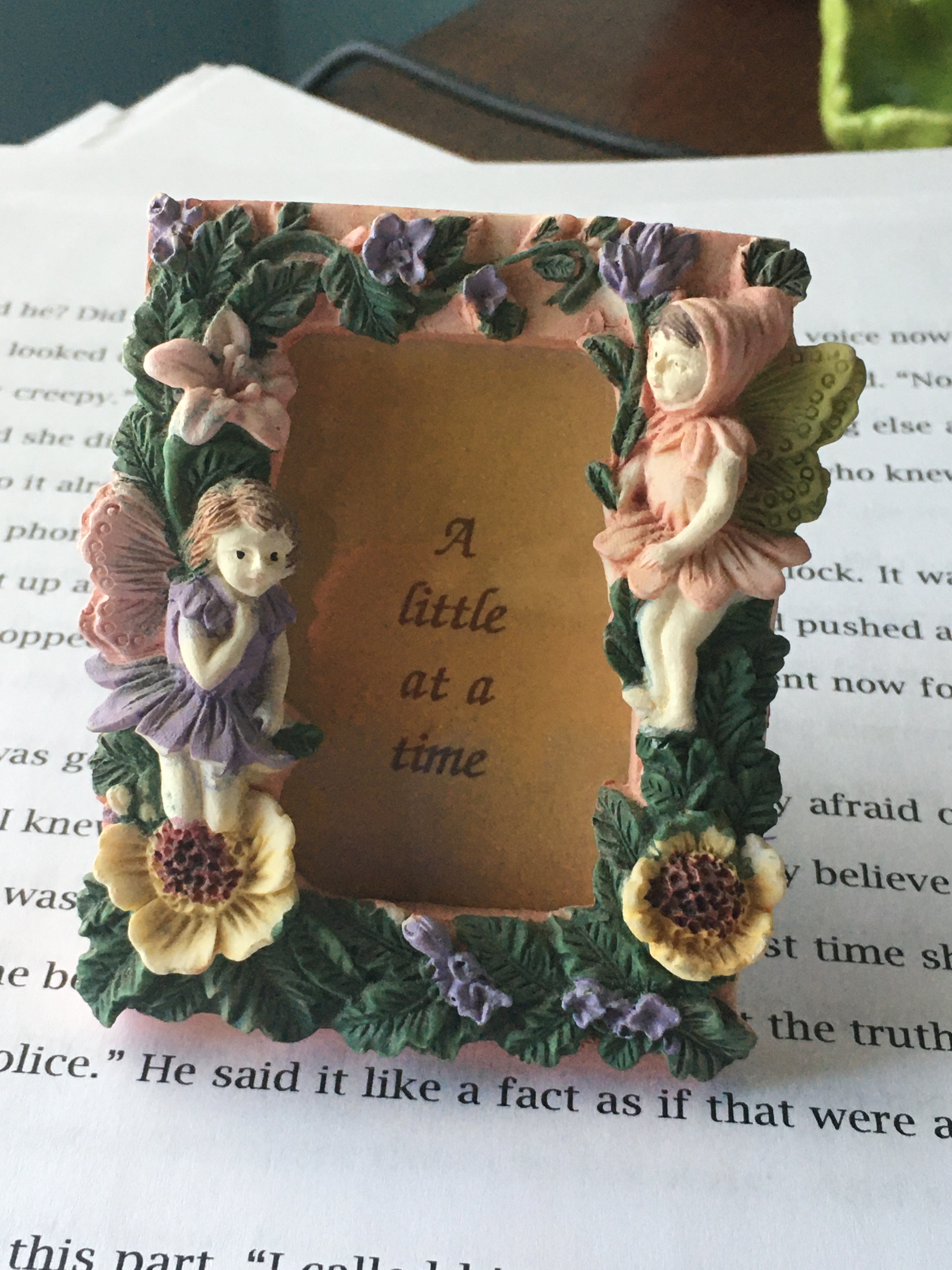
On my desk I have a tiny frame given to me by a student my first year of teaching third grade. Two fairies surrounded by flowers float around the edge and in it is a reminder I typed for myself years ago.

IMG_2663

I first framed my mantra when I had stacks of correcting, first in elementary school, then in middle school where I had hundreds of pieces of writing from students in grades five through eight. Instead of letting myself be overwhelmed, I remembered: A little at a time. It is important to remember this when it comes to my writing.

I have always thought of myself as a patient person, which has been most helpful as a parent and a teacher,  now as a grandparent, and always as a wife. As a writer, though, my patience often deserts me. In a first draft I sometimes find myself careening through a chapter instead of focusing as I should on all the small and important details that make the story richer. I get so involved sometimes in two characters having a conversation that I have pages of dialogue and not much else. These conversations are important and revealing for sure, but I know if I don’t slow down a bit and pay attention, I may miss something — a gesture, a smell or a sound, a look — details that can affect everything about the story.

I don’t have a specific word or page count that I strive for every day. Each day brings its responsibilities and demands on time, but as long as I write and feel I made progress, moved the story along and learned something about my characters, questioned things I thought I knew, it is a good day of writing.

As I revise, it is clear which pages I wrote a little too quickly and didn’t listen as closely as I should have. I’m patiently listening now, slowing down as I reread and retype and learn. A little at a time.

I’m Not Sure

A few weeks ago, I gave a friend a ride home from our writers’ group. Three of us had met and shared our writing and talked about experiences and processes, joys and challenges. One of the challenges we talked about was how it was difficult sometimes to just sit down and write, to move forward with our stores. On the drive, my friend asked why I thought it was difficult for me, why I sometimes resisted writing. My answer was vague, something that pretty much amounted to, “I’m not sure.”

I think about that conversation now and realize my response was right. After working on my second novel for more than a year, I’m not sure I know my characters well enough. And if I don’t know my characters well enough, how can I write their story? But then, if I don’t write the story, if I don’t put them in situations and let them talk and react, how can I get to know my characters better? I can’t.

I have read many books and articles and have been to workshops about character development, about writing descriptions of characters, putting them in hypothetical situations, about filling out questionnaires, even exploring their zodiac signs. I don’t think any of these approaches or exercises are without merit; they could provide valuable insights for sure. But for me, besides having characters in my head, I need to see them in the story I am writing. I need to see them in situations that come up in this particular story. Their story.

While I am writing, though, I need to be very careful that their words and actions are true in the situations that unfold. I need to be very careful that I don’t have them react the way I think they should, the way I or someone I know would, but I have to let them say and do what they will. Such a fine line between being the author of a story and letting the characters be in charge, but so it goes.

I recently finished reading Olive Kitteridge by Elizabeth Strout. I love that book. I love the power and honesty of the stories and the richness of every one of the characters. I heard Elizabeth Strout tell Oprah recently that her character, Olive, came to her “fully formed.” Fully formed. My immediate thought was how fortunate Elizabeth Strout was. For me, it is a much slower process, but a deliberate one, and I realize I am just as fortunate as Elizabeth Strout. It is more gradual, like a picture slowly developing, but eventually, when I persist, my characters become fully formed for me as well.

So, being unsure is not such a terrible thing, unless I let it stop me from showing up to write. Instead, I can use it to move forward, to give my characters a complex world to live in, trusting them to engage with their world and each other and reveal themselves more and more, just as they trust me to get it right.

Trust The Process

One of the most important lessons I have learned over years of writing is to trust the process. That being said, what exactly is the process? For me, it’s a messy one.

First, of course, is the simple (or not simple) act of moving the pen across the paper or pressing the keys. I need to trust that by doing this I am going to be able to create a rich and meaningful story. The first words are often not incredibly well-written, usually lacking depth and sensory detail, but they move me towards something true.

Much of the time I do not have a clear idea of what is going to happen, exactly what a character is going to say or do, until it is visible on paper or on the screen. The process of putting down one word after another, one sentence following another to create a scene, brings knowledge and insight and truth.

A little more than 45,000 words into my new novel, I had about fourteen chapters from three different points of view. As I learned about the lives and secrets and goals of my characters, I had written a few flashbacks throughout, images and scenes and conversations my characters revealed to me. Sometimes they blurted something out and sometimes they whispered, but it was all important and became part of the chapter, even if it didn’t fit neatly into the scene.

At one point, I thought of beginning each chapter with a scene from the past, in italics, then getting on with what was happening in the present. An awful idea.

This past weekend, I restarted the novel. I pulled out most or all of the scenes that happened in the past and used them to create new and better beginning chapters.  Now I am revising what I have so far, the scenes and chapters that come after, and they are richer for knowing what came before.