I’m Not Sure

A few weeks ago, I gave a friend a ride home from our writers’ group. Three of us had met and shared our writing and talked about experiences and processes, joys and challenges. One of the challenges we talked about was how it was difficult sometimes to just sit down and write, to move forward with our stores. On the drive, my friend asked why I thought it was difficult for me, why I sometimes resisted writing. My answer was vague, something that pretty much amounted to, “I’m not sure.”

I think about that conversation now and realize my response was right. After working on my second novel for more than a year, I’m not sure I know my characters well enough. And if I don’t know my characters well enough, how can I write their story? But then, if I don’t write the story, if I don’t put them in situations and let them talk and react, how can I get to know my characters better? I can’t.

I have read many books and articles and have been to workshops about character development, about writing descriptions of characters, putting them in hypothetical situations, about filling out questionnaires, even exploring their zodiac signs. I don’t think any of these approaches or exercises are without merit; they could provide valuable insights for sure. But for me, besides having characters in my head, I need to see them in the story I am writing. I need to see them in situations that come up in this particular story. Their story.

While I am writing, though, I need to be very careful that their words and actions are true in the situations that unfold. I need to be very careful that I don’t have them react the way I think they should, the way I or someone I know would, but I have to let them say and do what they will. Such a fine line between being the author of a story and letting the characters be in charge, but so it goes.

I recently finished reading Olive Kitteridge by Elizabeth Strout. I love that book. I love the power and honesty of the stories and the richness of every one of the characters. I heard Elizabeth Strout tell Oprah recently that her character, Olive, came to her “fully formed.” Fully formed. My immediate thought was how fortunate Elizabeth Strout was. For me, it is a much slower process, but a deliberate one, and I realize I am just as fortunate as Elizabeth Strout. It is more gradual, like a picture slowly developing, but eventually, when I persist, my characters become fully formed for me as well.

So, being unsure is not such a terrible thing, unless I let it stop me from showing up to write. Instead, I can use it to move forward, to give my characters a complex world to live in, trusting them to engage with their world and each other and reveal themselves more and more, just as they trust me to get it right.
Trust The Process

One of the most important lessons I have learned over years of writing is to trust the process. That being said, what exactly is the process? For me, it’s a messy one.

First, of course, is the simple (or not simple) act of moving the pen across the paper or pressing the keys. I need to trust that by doing this I am going to be able to create a rich and meaningful story. The first words are often not incredibly well-written, usually lacking depth and sensory detail, but they move me towards something true.

Much of the time I do not have a clear idea of what is going to happen, exactly what a character is going to say or do, until it is visible on paper or on the screen. The process of putting down one word after another, one sentence following another to create a scene, brings knowledge and insight and truth.

A little more than 45,000 words into my new novel, I had about fourteen chapters from three different points of view. As I learned about the lives and secrets and goals of my characters, I had written a few flashbacks throughout, images and scenes and conversations my characters revealed to me. Sometimes they blurted something out and sometimes they whispered, but it was all important and became part of the chapter, even if it didn’t fit neatly into the scene.

At one point, I thought of beginning each chapter with a scene from the past, in italics, then getting on with what was happening in the present. An awful idea.

This past weekend, I restarted the novel. I pulled out most or all of the scenes that happened in the past and used them to create new and better beginning chapters.  Now I am revising what I have so far, the scenes and chapters that come after, and they are richer for knowing what came before.

The Second Novel

I was never sure I would write a second novel and rarely thought about it while I was working on the first. For a long time, years, I wasn’t sure I was writing the first one. Most of the time I knew I was writing something, but not until the story grew and developed and the characters became whole did I dare to admit I was writing a novel.

The second one has all the challenges and joys of the first — the discovery as I write and think about these characters and their story, the fear I won’t be able to get it right, that I will take wrong paths, all the wanting that comes with creating something. But this time, I know I am writing a novel.

This time I set out to write a novel and I know I can, as long as I show up every day.  If I have learned anything from writing a first novel, it’s that I have to show up every day.

The Path

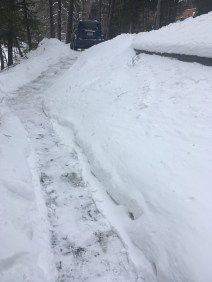
We have a good friend, Jim Lord, who digs us out at the lake house during the winter. This morning he was here at seven, plowed the best he could with my car  there, and shoveled a walkway from the car to the front door.IMG_1974

I put on my boots and jacket and gloves a few hours later and went outside to clear off the car and shovel the small mountain range left  by the street plow. It was windy and cold, but there were intermittent breaks of bright sunshine. By the time I finished and walked back towards the house, the path was lightly covered with snow again, the steps a little slippery.

And so it is with writing.

Speaking of the Novel

There are probably millions of people in the United States who belong to a book club. Although I don’t belong to one right now, I was fortunate enough to be invited to one a few days ago to discuss A Better Life.

IMG_1938.JPG

It is an amazing experience listening to people, some I have known for years and some I just met, discussing Margaret and Jenny, Gene and even Darlene. They talked about Jenny’s family background and they asked many questions about the story which were often answered by another reader. Perhaps the most interesting comments for me were about the ending; readers have been pretty divided on whether they were satisfied with it or not. The fact that many readers want more of Jenny and Margaret’s story is a wonderful thing for this author.

What I loved sharing most was the process of writing the novel. The getting to know the characters, the characters surprising me at times, either by their actions or their reactions. People are amazed that I don’t know what the characters will do or say in advance, that there isn’t more planning or outlining involved. I explained that there are many authors who do outline and plan much of what they write and that is their process, but not mine.

People in the book club were amazed that I know and care so deeply about my characters. That my characters become so very real to me is part of what makes writing special. It is a mysterious process to people who don’t write, as well as to people like me who do.