I’m Not Sure

A few weeks ago, I gave a friend a ride home from our writers’ group. Three of us had met and shared our writing and talked about experiences and processes, joys and challenges. One of the challenges we talked about was how it was difficult sometimes to just sit down and write, to move forward with our stores. On the drive, my friend asked why I thought it was difficult for me, why I sometimes resisted writing. My answer was vague, something that pretty much amounted to, “I’m not sure.”

I think about that conversation now and realize my response was right. After working on my second novel for more than a year, I’m not sure I know my characters well enough. And if I don’t know my characters well enough, how can I write their story? But then, if I don’t write the story, if I don’t put them in situations and let them talk and react, how can I get to know my characters better? I can’t.

I have read many books and articles and have been to workshops about character development, about writing descriptions of characters, putting them in hypothetical situations, about filling out questionnaires, even exploring their zodiac signs. I don’t think any of these approaches or exercises are without merit; they could provide valuable insights for sure. But for me, besides having characters in my head, I need to see them in the story I am writing. I need to see them in situations that come up in this particular story. Their story.

While I am writing, though, I need to be very careful that their words and actions are true in the situations that unfold. I need to be very careful that I don’t have them react the way I think they should, the way I or someone I know would, but I have to let them say and do what they will. Such a fine line between being the author of a story and letting the characters be in charge, but so it goes.

I recently finished reading Olive Kitteridge by Elizabeth Strout. I love that book. I love the power and honesty of the stories and the richness of every one of the characters. I heard Elizabeth Strout tell Oprah recently that her character, Olive, came to her “fully formed.” Fully formed. My immediate thought was how fortunate Elizabeth Strout was. For me, it is a much slower process, but a deliberate one, and I realize I am just as fortunate as Elizabeth Strout. It is more gradual, like a picture slowly developing, but eventually, when I persist, my characters become fully formed for me as well.

So, being unsure is not such a terrible thing, unless I let it stop me from showing up to write. Instead, I can use it to move forward, to give my characters a complex world to live in, trusting them to engage with their world and each other and reveal themselves more and more, just as they trust me to get it right.
The Second Novel

I was never sure I would write a second novel and rarely thought about it while I was working on the first. For a long time, years, I wasn’t sure I was writing the first one. Most of the time I knew I was writing something, but not until the story grew and developed and the characters became whole did I dare to admit I was writing a novel.

The second one has all the challenges and joys of the first — the discovery as I write and think about these characters and their story, the fear I won’t be able to get it right, that I will take wrong paths, all the wanting that comes with creating something. But this time, I know I am writing a novel.

This time I set out to write a novel and I know I can, as long as I show up every day.  If I have learned anything from writing a first novel, it’s that I have to show up every day.

Where I Write

I am always curious to hear about where other writers write and I often come across writers who need a blank wall in front of them, a place that blocks out every bit of this world so they can concentrate only on their story. No windows, no anything.

Annie Dillard says in The Writing Life, “Appealing workplaces are to be avoided. One wants a room with no view so imagination can meet memory in the dark.”

This would not work for me. I am fortunate to have three most appealing workplaces in which I write. At home in Lowell, I write at the dining room table with the wall of seven windows on my right, looking out onto the back yard, glimpses of the nearby houses beyond the fence, the sky and trees, brilliant sunshine often filling the room.

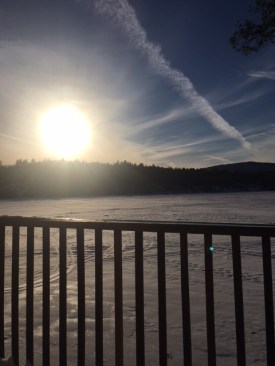
At our lake house in Newbury, I write at my little round table facing the lake with the ever-changing scene outside the sliders, beyond the deck to the now snow-covered lake IMG_1966and islands, trees and mountains, all surrounded by a sky that transforms moment to moment. I go from the table where I hand-write new material and edit what has been done, to the computer to enter new words and sentences and chapters to be saved and cherished now and reviewed later.

Sometimes after a couple of days of solitude at the lake, I feel the call of the outside world and know it is time to venture out and be among  people in addition to my characters. I may go to church and I may visit my books at Morgan Hill Bookstore or MainStreet BookEnds, but I usually end up at Bubba’s in Newbury Harbor to write.

I push away the salt and pepper and make room for my notebook. I have a small table in the bar area where there is a welcoming mix of people, voices and laughter. I settle in, and as I write I listen to pieces of conversation, orders, questions, a recitation of the sides. It is familiar and comfortable and the people who work there and take care of me always make me feel like I could sit there all day if I wanted. After an IPA and lunch, I gather my pages and set off for home, full of the day and excited about my new pages of writing and notes.

I have discovered that where I write is not actually at the lake house or at Bubba’s or at home; where I write is where my story is.

If you would like to leave a comment about where you write, it would be most welcome.

Just Write

I saw one of my former middle school students last summer. She was working as a hostess at a restaurant while pursuing her degree at Middlesex Community College. We talked for a few minutes and she told me she thinks of me every time she sits down to write a paper for school.

“Even if I have no idea where it’s going, I just write. That’s what you always told us. Just write. So that’s what I do and it always works.”

Wise girl.

I have told this to hundreds of students over the years, and it is exactly what I need to remember when I sit down to write and don’t have a clear and definite knowing of where I am going. The act of writing, putting pen to paper or fingers on the keys encourages thoughts and details to come out and eventually something meaningful will emerge — a single sentence that leads to another, a paragraph that makes you feel something. I told them about the joy I experience when I am writing and something surprises me, when a character does or says something I didn’t expect. Students were skeptical at first, but they always liked that idea because there is something magical about it. Sometimes in class a student would exclaim, “Mrs. Murphy! It just happened to me, what you said about being surprised!” And I knew it was true because of the light in the student’s eyes and the way the pencil continued to fly across the paper.

Writing is discovering. Writing is sitting with a blank piece of paper and creating something that has never existed before. That is something else I shared with my students that inspired them to put their own words on paper. It is magic that both children and adults can believe in. The act of creation. Good or bad, we do our best at the time with what we have within us and what we are brave enough to share.

It is a gift to have my words come back to me exactly when I need them.

I’m Not Lost

Sometimes I feel so lost I can’t take one more step.

I am somewhere in the new story. I realized yesterday I am losing my characters, which tells me I have written something not true, so not true that the people whose stories I am supposed to tell are turning their backs on me, and I don’t blame them. It is time to stop, go back to the beginning so I can see more clearly what my characters are trying to tell me. They want to tell me who they are and I need to listen.

The marketing and promotion of A Better Life is different now than just three weeks ago. It doesn’t have that brand-new feeling anymore. A lot of people have bought the book, for which I am forever grateful, and now I am getting some reactions and comments. I welcome them all. I am looking forward to meeting with two book clubs in the next few months and hearing comments, answering questions as best I can, and discussing the story and characters.

I am not lost forever. I am looking ahead and even though I don’t see a well-defined, clear trail ahead, that doesn’t mean I am lost. It means I can make choices and look for different ways of promoting A Better Life that make sense in my mind and heart. And it means there is a lot of room for my new cast of characters to come alive.