Motivation

When I began teaching, I was thrilled at how intrinsically motivated my third-graders were. They were excited about learning new things and I did my best to nurture their passion. There was a lot of discussion and controversy at the time about giving rewards to students for learning and how it could affect them in the future. It seemed to me as a novice teacher that rewarding students with prizes or parties could diminish their natural, intrinsic motivation and they would learn and work hard only if there was some kind of tangible reward.

As a new author with my first published book out in the world and working on my second, I am finding that rewards go a long way in motivating me to work even harder — on my writing, my marketing, virtually my whole writing career. My granddaughter Leah recently asked me if I was going to get rich from my book. I smiled and told her no, and explained that wasn’t why I wrote and published, that I love writing and telling a story and am just happy people are reading my book. The rewards that motivate me are not as tangible as money.

I was contacted recently by Prudence Brighton, a freelance writer who wanted to interview me for a feature article in The Lowell Sun. This was my first interview as an author.  Yesterday, I had a telephone interview with Angie Sykeny, a reporter from HippoPress, a New Hampshire weekly. Discussing and answering questions about A Better Life, talking about the story, the characters, my writing process, my background, was an incredibly motivating reward.

I am forever grateful to and motivated by everyone who takes the time to read and discuss my novel, my blog, and the articles that will soon appear in The Lowell Sun and HippoPress, with hopefully more to come. I was wrong all those years ago when I believed motivation had to come totally from within. There can be a beautiful balance.
Trust The Process

One of the most important lessons I have learned over years of writing is to trust the process. That being said, what exactly is the process? For me, it’s a messy one.

First, of course, is the simple (or not simple) act of moving the pen across the paper or pressing the keys. I need to trust that by doing this I am going to be able to create a rich and meaningful story. The first words are often not incredibly well-written, usually lacking depth and sensory detail, but they move me towards something true.

Much of the time I do not have a clear idea of what is going to happen, exactly what a character is going to say or do, until it is visible on paper or on the screen. The process of putting down one word after another, one sentence following another to create a scene, brings knowledge and insight and truth.

A little more than 45,000 words into my new novel, I had about fourteen chapters from three different points of view. As I learned about the lives and secrets and goals of my characters, I had written a few flashbacks throughout, images and scenes and conversations my characters revealed to me. Sometimes they blurted something out and sometimes they whispered, but it was all important and became part of the chapter, even if it didn’t fit neatly into the scene.

At one point, I thought of beginning each chapter with a scene from the past, in italics, then getting on with what was happening in the present. An awful idea.

This past weekend, I restarted the novel. I pulled out most or all of the scenes that happened in the past and used them to create new and better beginning chapters.  Now I am revising what I have so far, the scenes and chapters that come after, and they are richer for knowing what came before.

The Second Novel

I was never sure I would write a second novel and rarely thought about it while I was working on the first. For a long time, years, I wasn’t sure I was writing the first one. Most of the time I knew I was writing something, but not until the story grew and developed and the characters became whole did I dare to admit I was writing a novel.

The second one has all the challenges and joys of the first — the discovery as I write and think about these characters and their story, the fear I won’t be able to get it right, that I will take wrong paths, all the wanting that comes with creating something. But this time, I know I am writing a novel.

This time I set out to write a novel and I know I can, as long as I show up every day.  If I have learned anything from writing a first novel, it’s that I have to show up every day.

On The Road

My husband and I prefer road trips to any other travel. Since publishing A Better Life, our road trips have been fairly local, to independent book stores in Massachusetts and New Hampshire. The other day we visited one in Milford and one in Peterborough, New Hampshire. They were the first two bookstores that did not accept any books on consignment, and while I was disappointed, it was totally understandable from a business point of view. It wasn’t unlike receiving a rejection letter or email for a submitted short story or a thank-you from an agent saying my work wasn’t a good fit.

It was far from a wasted trip, however, as the manager in Milford steered me to and gave me contact information for the New Hampshire Writers’ Project (www.nhwritersproject.org). I learned about their “Brick and Mortar” program, where they help local authors get into independent bookstores. I also signed up for their one-day writers’ conference on April 27, where I will participate in workshops in scene, setting, and character-driven plot. And most importantly of all, I will be with other writers. It has been too long.

The next day we visited Gibson’s Bookstore in Concord, New Hampshire, where they readily accepted three copies of my novel to add to their shelves of local authors. Having books out there, on the shelves of five bookstores and on the counter of one salon, brings a deep sense of satisfaction.

The Path

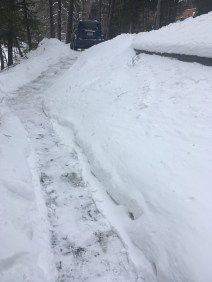
We have a good friend, Jim Lord, who digs us out at the lake house during the winter. This morning he was here at seven, plowed the best he could with my car  there, and shoveled a walkway from the car to the front door.IMG_1974

I put on my boots and jacket and gloves a few hours later and went outside to clear off the car and shovel the small mountain range left  by the street plow. It was windy and cold, but there were intermittent breaks of bright sunshine. By the time I finished and walked back towards the house, the path was lightly covered with snow again, the steps a little slippery.

And so it is with writing.