Trust The Process

One of the most important lessons I have learned over years of writing is to trust the process. That being said, what exactly is the process? For me, it’s a messy one.

First, of course, is the simple (or not simple) act of moving the pen across the paper or pressing the keys. I need to trust that by doing this I am going to be able to create a rich and meaningful story. The first words are often not incredibly well-written, usually lacking depth and sensory detail, but they move me towards something true.

Much of the time I do not have a clear idea of what is going to happen, exactly what a character is going to say or do, until it is visible on paper or on the screen. The process of putting down one word after another, one sentence following another to create a scene, brings knowledge and insight and truth.

A little more than 45,000 words into my new novel, I had about fourteen chapters from three different points of view. As I learned about the lives and secrets and goals of my characters, I had written a few flashbacks throughout, images and scenes and conversations my characters revealed to me. Sometimes they blurted something out and sometimes they whispered, but it was all important and became part of the chapter, even if it didn’t fit neatly into the scene.

At one point, I thought of beginning each chapter with a scene from the past, in italics, then getting on with what was happening in the present. An awful idea.

This past weekend, I restarted the novel. I pulled out most or all of the scenes that happened in the past and used them to create new and better beginning chapters.  Now I am revising what I have so far, the scenes and chapters that come after, and they are richer for knowing what came before.
The Second Novel

I was never sure I would write a second novel and rarely thought about it while I was working on the first. For a long time, years, I wasn’t sure I was writing the first one. Most of the time I knew I was writing something, but not until the story grew and developed and the characters became whole did I dare to admit I was writing a novel.

The second one has all the challenges and joys of the first — the discovery as I write and think about these characters and their story, the fear I won’t be able to get it right, that I will take wrong paths, all the wanting that comes with creating something. But this time, I know I am writing a novel.

This time I set out to write a novel and I know I can, as long as I show up every day.  If I have learned anything from writing a first novel, it’s that I have to show up every day.

On The Road

My husband and I prefer road trips to any other travel. Since publishing A Better Life, our road trips have been fairly local, to independent book stores in Massachusetts and New Hampshire. The other day we visited one in Milford and one in Peterborough, New Hampshire. They were the first two bookstores that did not accept any books on consignment, and while I was disappointed, it was totally understandable from a business point of view. It wasn’t unlike receiving a rejection letter or email for a submitted short story or a thank-you from an agent saying my work wasn’t a good fit.

It was far from a wasted trip, however, as the manager in Milford steered me to and gave me contact information for the New Hampshire Writers’ Project (www.nhwritersproject.org). I learned about their “Brick and Mortar” program, where they help local authors get into independent bookstores. I also signed up for their one-day writers’ conference on April 27, where I will participate in workshops in scene, setting, and character-driven plot. And most importantly of all, I will be with other writers. It has been too long.

The next day we visited Gibson’s Bookstore in Concord, New Hampshire, where they readily accepted three copies of my novel to add to their shelves of local authors. Having books out there, on the shelves of five bookstores and on the counter of one salon, brings a deep sense of satisfaction.

The Path

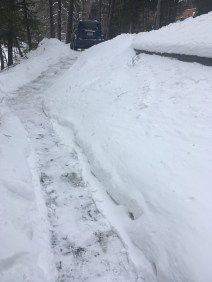
We have a good friend, Jim Lord, who digs us out at the lake house during the winter. This morning he was here at seven, plowed the best he could with my car  there, and shoveled a walkway from the car to the front door.IMG_1974

I put on my boots and jacket and gloves a few hours later and went outside to clear off the car and shovel the small mountain range left  by the street plow. It was windy and cold, but there were intermittent breaks of bright sunshine. By the time I finished and walked back towards the house, the path was lightly covered with snow again, the steps a little slippery.

And so it is with writing.

Where I Write

I am always curious to hear about where other writers write and I often come across writers who need a blank wall in front of them, a place that blocks out every bit of this world so they can concentrate only on their story. No windows, no anything.

Annie Dillard says in The Writing Life, “Appealing workplaces are to be avoided. One wants a room with no view so imagination can meet memory in the dark.”

This would not work for me. I am fortunate to have three most appealing workplaces in which I write. At home in Lowell, I write at the dining room table with the wall of seven windows on my right, looking out onto the back yard, glimpses of the nearby houses beyond the fence, the sky and trees, brilliant sunshine often filling the room.

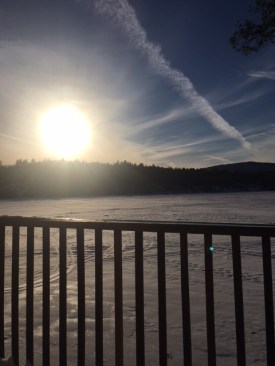
At our lake house in Newbury, I write at my little round table facing the lake with the ever-changing scene outside the sliders, beyond the deck to the now snow-covered lake IMG_1966and islands, trees and mountains, all surrounded by a sky that transforms moment to moment. I go from the table where I hand-write new material and edit what has been done, to the computer to enter new words and sentences and chapters to be saved and cherished now and reviewed later.

Sometimes after a couple of days of solitude at the lake, I feel the call of the outside world and know it is time to venture out and be among  people in addition to my characters. I may go to church and I may visit my books at Morgan Hill Bookstore or MainStreet BookEnds, but I usually end up at Bubba’s in Newbury Harbor to write.

I push away the salt and pepper and make room for my notebook. I have a small table in the bar area where there is a welcoming mix of people, voices and laughter. I settle in, and as I write I listen to pieces of conversation, orders, questions, a recitation of the sides. It is familiar and comfortable and the people who work there and take care of me always make me feel like I could sit there all day if I wanted. After an IPA and lunch, I gather my pages and set off for home, full of the day and excited about my new pages of writing and notes.

I have discovered that where I write is not actually at the lake house or at Bubba’s or at home; where I write is where my story is.

If you would like to leave a comment about where you write, it would be most welcome.